Supply chain disruption is no longer an exception. It has become part of everyday planning.
A port strike, a road closure, a supplier issue, a weather event or a geopolitical shock can quickly create delays, shortages and additional costs. For planning teams, the challenge is not only to react when something goes wrong. The real challenge is to see risks early enough to make better decisions.
This is where artificial intelligence can change the way companies manage supply chain risk.
AI will not stop disruption from happening. It will not prevent a storm, a strike or a supplier delay. But it can help teams detect weak signals earlier, connect external events to supplier locations, and alert planners before the impact reaches the business.
In other words, AI can help supply chains move from reaction to anticipation.
Why disruption is so difficult to manage
Supply chains are more connected than ever. A delay in one region can affect production, inventory availability, customer service and financial performance in another.
The problem is that most disruptions do not arrive neatly inside a planning system. They often start outside the company: in regional news, weather reports, transport networks, ports, supplier sites or local events.
By the time the information reaches the planner, it may already be too late.
Traditional planning tools are good at managing internal data: demand, inventory, orders, lead times and production plans. But they are not always designed to monitor external risks in real time.
That creates a visibility gap.
Teams may know what is happening inside their ERP or planning system, but they do not always know what is happening around their suppliers. And when disruption appears, they often have to search manually for information, confirm the risk, understand the impact and decide what to do next.
AI can help close that gap.
AI as an early-warning system
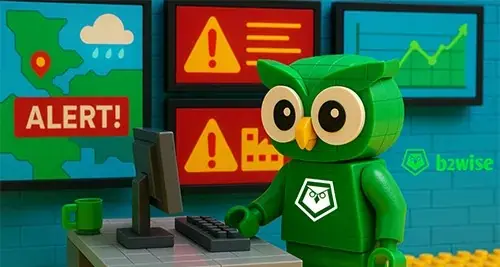
An AI-powered early-warning system works like a supply chain radar.
It scans external signals, detects potential events, links them to relevant locations or suppliers, and pushes alerts to the people who need to act. The goal is not to create more noise. The goal is to turn scattered information into useful planning signals.
For example, if a regional strike, flood, road closure or port issue is detected near a supplier location, the system can alert the planner before the disruption becomes visible in delivery performance.
That changes the conversation.
Instead of discovering the problem after the delay, the planner can start asking better questions earlier: is this supplier affected? Which materials are at risk? Do we have enough stock? Can we adjust priorities? Do we need to inform production or customer service?
Early visibility gives teams time to respond.
From information overload to useful alerts
One of the biggest challenges in supply chain risk management is not a lack of information. It is too much information.
News, emails, reports, supplier updates and operational alerts can quickly become overwhelming. If every signal is treated as urgent, planners lose focus. If too many alerts are irrelevant, teams stop trusting the system.
This is where AI can add value.
AI can help filter signals, identify patterns and prioritize the risks that are most likely to matter. Instead of asking planners to monitor everything manually, it can surface the events that deserve attention.
The value is not just detection. It is prioritization.
A good alert should help the planner understand what happened, where it happened, which supplier or flow may be affected, and what decision needs to be considered. Without that context, an alert is just another notification.
Why speed matters in supply chain resilience
In disruption management, time is often the most valuable resource.
The earlier a team sees a risk, the more options it has. It may be possible to adjust stock priorities, contact a supplier, reroute transport, change a production sequence, review customer commitments or prepare an alternative scenario.
When the signal arrives too late, choices become limited. Teams move into emergency mode. Costs increase. Service levels suffer. Planners spend their time firefighting instead of managing flow.
AI helps improve resilience by giving teams more time to act.
This does not mean every risk can be avoided. But even when disruption cannot be prevented, it can often be managed better with earlier visibility and clearer priorities.
AI does not replace the planner
AI can detect signals and suggest risks, but it does not replace human judgment.
Supply chain decisions depend on business context. A planner needs to understand customer priorities, supplier relationships, inventory constraints, production realities and strategic trade-offs.
An AI alert can say that a supplier may be exposed to a regional disruption. But the planner still needs to decide what action makes sense.
Should the team expedite orders? Use available inventory differently? Inform sales? Contact the supplier? Wait for confirmation? Each decision depends on context.
The most useful AI tools are therefore not the ones that try to automate every decision. They are the ones that help planners focus on the right problems faster.
The importance of a clear response playbook
Detecting a risk is only the first step.
Many early-warning systems fail because they identify issues but do not help teams act. If no one knows who should check the alert, how the risk should be confirmed, or what the next step should be, the value of early detection is limited.
That is why companies need a clear response playbook.
A good playbook defines what happens after an alert: who reviews it, how the impact is assessed, which stakeholders need to be informed, and what actions can be taken depending on the level of risk.
The combination of AI alerts and clear operational rules is what turns information into action.
Without a process, AI creates visibility. With a process, it creates resilience.
How AI supports smaller and mid-sized companies
AI-powered risk detection is not only useful for large global corporations.
Smaller and mid-sized companies also face disruption. They may have fewer suppliers, smaller planning teams or less complex networks, but they still need visibility. In many cases, they cannot afford to lose time searching manually for risk information.
AI can help make advanced risk monitoring more accessible.
Instead of building a large internal risk team, companies can use AI to monitor external signals, connect them to supplier data and alert planners when something needs attention.
This helps level the playing field. It gives more companies access to capabilities that were previously reserved for larger organizations with bigger teams and larger budgets.
How b2wise helps teams anticipate disruption
At b2wise, we believe AI should support practical planning decisions.
Supply chain teams do not need more dashboards for the sake of dashboards. They need tools that help them detect risks earlier, understand what is affected, and decide what to do next.
By connecting external risk signals with supplier and planning data, AI can help planners move from reactive firefighting to proactive decision-making. It supports better visibility, faster prioritization and stronger resilience across the supply chain.
The goal is not to predict every disruption perfectly. The goal is to give teams more time, more clarity and better options when disruption appears.
Conclusion
You cannot stop every disruption. But you can improve the way your supply chain sees, understands and responds to risk.
AI helps planning teams detect external signals earlier, connect them to supplier exposure, prioritize alerts and prepare better responses. Its value is not in replacing planners, but in giving them the information they need sooner.
In a world where disruption has become normal, resilience depends on visibility, speed and decision quality.
AI can help supply chains see risk coming before it becomes a crisis.

.webp)