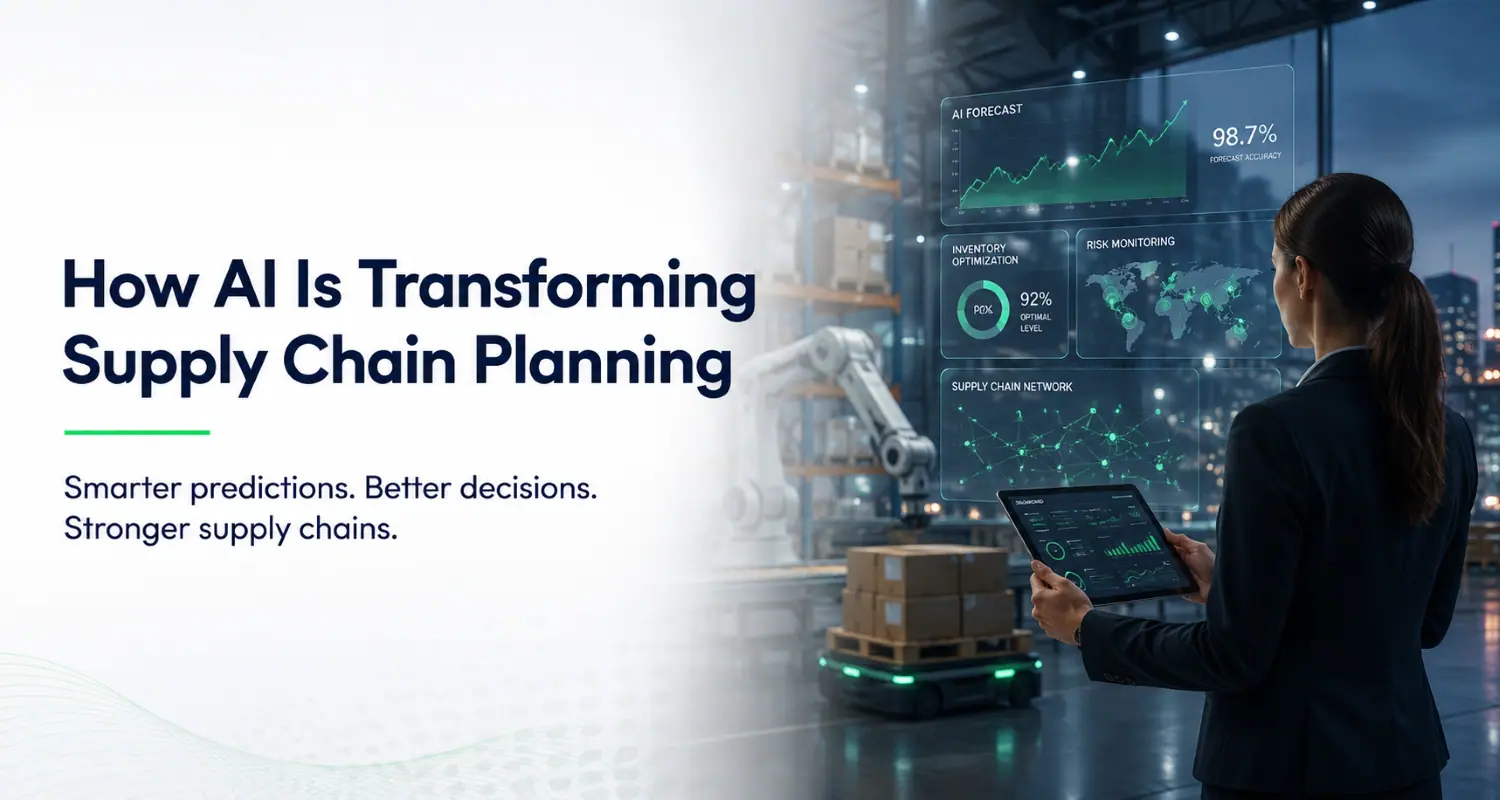
Artificial intelligence is rapidly becoming one of the most discussed topics in supply chain management. But beyond the hype, companies are asking a more practical question: how is AI actually transforming supply chain planning?
For planners, the challenge is not simply to adopt new technology. It is to improve decision-making in an environment that is more volatile, more connected, and more demanding than ever. Forecast errors, stock imbalances, late supplier signals, and growing customer expectations all put pressure on planning teams. In that context, AI is no longer seen as a futuristic add-on. It is becoming a useful lever to support better planning decisions.
AI does not replace supply chain planning fundamentals. It strengthens them. It helps companies analyze more data, identify patterns faster, react earlier, and support planners with more relevant recommendations.
Why AI matters in supply chain planning
Traditional planning approaches often depend on historical data, fixed parameters, and manual analysis. These methods can still work in stable environments, but they become harder to manage when variability increases.
Demand changes more quickly. Supply disruptions happen more often. Product portfolios become more complex. At the same time, businesses are expected to improve service levels without increasing working capital.
This is where AI brings value. It helps planners move from a reactive approach to a more adaptive one. Instead of only looking at what happened in the past, AI can help identify what is changing now and what may happen next.
In supply chain planning, this means better visibility, faster analysis, and stronger support for decision-making.
Where AI creates value
One of the most visible applications of AI is in forecasting. AI models can process larger volumes of data than traditional methods and detect patterns that may not be obvious through manual analysis. This can improve forecast quality, especially when demand is influenced by multiple variables such as seasonality, promotions, customer behavior, or market changes.
But forecasting is only one part of the story.
AI can also improve inventory management by helping planners anticipate imbalances sooner. It can highlight abnormal consumption, identify potential stockout risks, and support more dynamic replenishment decisions. This is especially useful when companies need to balance service level, inventory investment, and responsiveness.
Another important contribution is exception management. Many planners spend too much time reviewing the same reports, chasing small issues, or manually checking data. AI can help prioritize attention by flagging the most critical alerts and surfacing the situations that really need human action. Instead of replacing planners, it helps them focus on higher-value decisions.
AI also supports scenario analysis. Planning teams often need to answer practical questions very quickly: what happens if demand increases sharply, if a supplier is delayed, or if inventory targets change? AI can help simulate possible outcomes and support faster decision-making across operations.
AI does not mean fully autonomous planning
One common misconception is that AI will run the supply chain by itself. In reality, the most effective use of AI is not about removing people from the process. It is about augmenting human decision-making.
Supply chain planning remains a business discipline. It requires judgement, context, collaboration, and trade-off management. AI can suggest patterns, recommendations, or risks, but it does not understand business priorities the way experienced planners do.
That is why companies should not see AI as a magic solution. The goal is not to automate everything. The goal is to make planning more relevant, faster, and more resilient.
In practice, the best results often come from combining AI capabilities with strong planning methods and clear operational rules.
The limits of AI in planning
AI can create real value, but only under the right conditions.
First, data quality matters. If the data is incomplete, outdated, or inconsistent, AI will not produce meaningful results. Poor data leads to poor recommendations. Before expecting value from AI, companies need a solid planning foundation.
Second, AI needs business context. A recommendation may look mathematically correct but still be operationally unrealistic. For example, a system may suggest a response that ignores supplier constraints, production realities, or strategic priorities. This is why human validation remains essential.
Third, AI should be connected to a planning process, not isolated from it. If AI outputs are not integrated into day-to-day planning workflows, adoption remains low and impact stays limited. Technology only creates value when planners can actually use it.
AI and demand-driven planning
AI becomes even more powerful when it supports a more adaptive planning model.
In traditional environments, planning often relies too heavily on forecast accuracy alone. But supply chains need more than prediction. They need mechanisms that can detect change and respond effectively.
That is why AI can complement demand-driven approaches. It can help companies better interpret demand signals, detect changes earlier, and improve decision-making around priorities, inventory, and replenishment. Rather than chasing a perfect forecast, companies can use AI to improve responsiveness and decision quality across the flow.
This is especially relevant for organizations that want to reduce stockouts, limit excess inventory, and improve agility without adding unnecessary complexity.
How AI helps planners in everyday work
For planners, the transformation is often very concrete.
AI can reduce time spent on repetitive analysis. It can help identify unusual demand behavior, highlight priority items, and support better conversations between teams. It can make planning meetings more efficient by providing faster access to relevant information. It can also support better alignment between supply, demand, and operational constraints.
The real impact is not only technical. It is organizational. AI helps planners shift from manually processing data to interpreting insights and making better decisions.
That change matters because modern supply chain performance depends on speed, clarity, and coordination.
How b2wise supports this transformation
At b2wise, we believe AI should support planning decisions in a practical and operational way. It should help companies gain visibility, improve flow, and make better decisions without losing control of the planning process.
That is why AI should not be treated as a standalone layer disconnected from operations. It should be part of a broader planning strategy that connects demand, supply, inventory, and execution.
For companies looking to improve planning performance, the question is not whether AI is relevant. The real question is how to use it in a way that creates measurable value.
Conclusion
AI is transforming supply chain planning by helping companies analyze more data, detect changes faster, improve forecasting, and support better decisions. Its value is not in replacing planners, but in making planning more responsive, more focused, and more effective.
The companies that benefit most from AI will not be the ones chasing hype. They will be the ones that combine the right technology with strong planning processes and a clear operational vision.
In that sense, AI is not the future of supply chain planning because it is fashionable. It is becoming part of the future because it helps planners deal with complexity in a smarter way.

.webp)