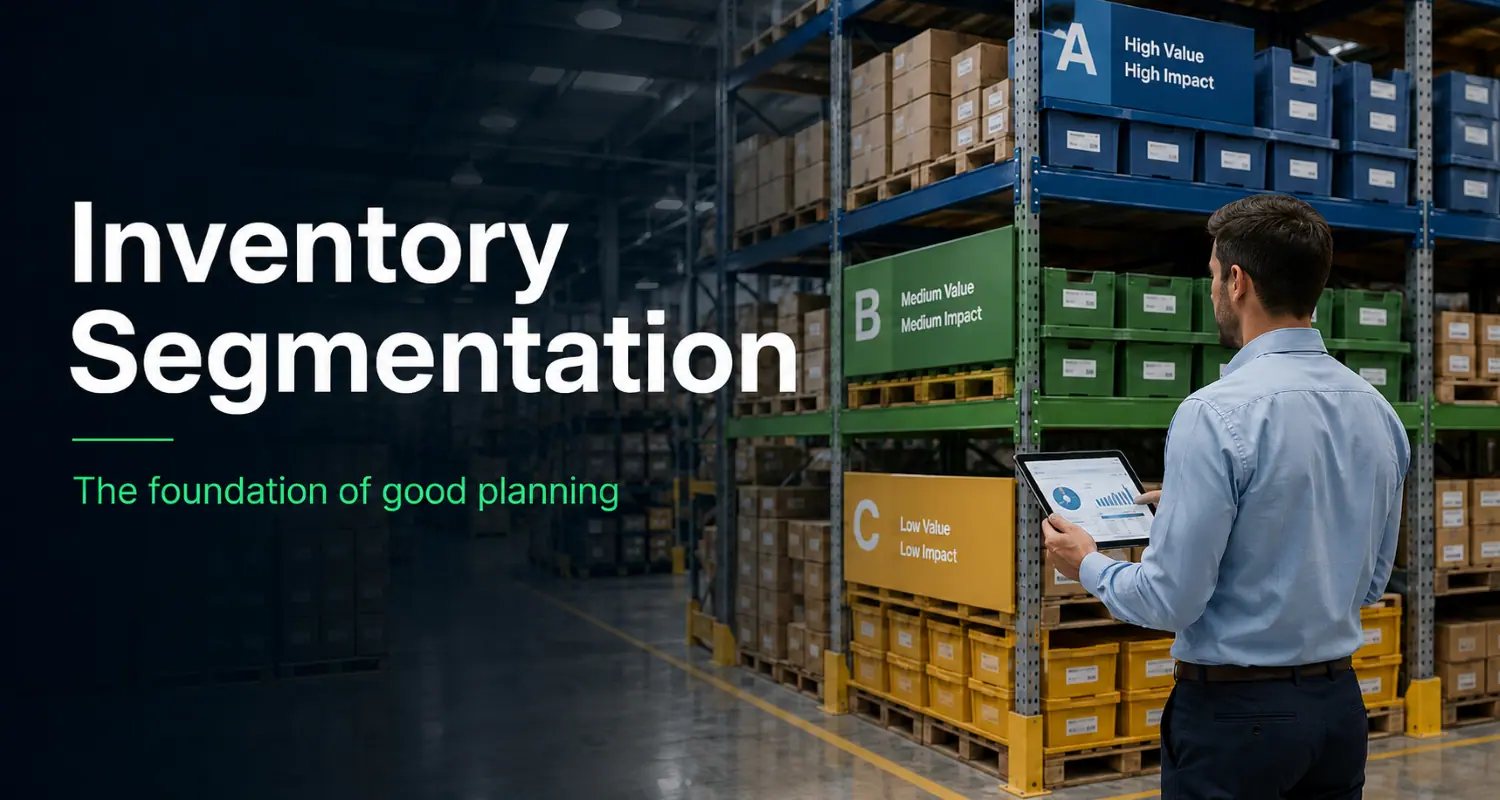
Segmentation is one of the foundations of good supply chain planning. Yet it is often underestimated.
In many companies, items are managed with rules that are too generic. The same forecasting methods, stock policies or replenishment rules are applied to products that behave very differently.
That is where problems begin.
A stable product with regular demand should not be managed in the same way as an intermittent item. A critical component with a long supplier lead time should not be treated like a product that is easy to replenish. An end-of-life item should not be planned like a new product.
Inventory segmentation helps avoid this one-size-fits-all approach. It classifies items according to their behavior, risk and importance to the business. From there, teams can adapt forecasts, stock levels, replenishment rules and operational priorities.
To go further, our complete guide to inventory management and replenishment explains how to avoid stockouts without creating excess inventory.
Why segment items?
Not all items behave in the same way.
Some have stable and predictable demand. Others are sold rarely but can become critical at the wrong moment. Some products are new and do not yet have reliable historical data. Others are reaching the end of their life cycle and must be managed carefully to avoid excess inventory.
If a company applies one method to all these cases, it risks making poor decisions. Stable items can often be managed with classic methods, but irregular or intermittent items require a more specific approach.
Segmentation therefore helps teams better understand each family of items and avoid overly automatic decisions. It gives planners a clearer view of demand, risk and priorities.
It is also an important lever for improving demand forecasting, because not all products can be forecast with the same level of reliability.
The main types of items to distinguish
Effective segmentation can take different forms depending on the company, industry and data available. But some groups are common.
New items, for example, are difficult to forecast because they do not yet have historical data. Teams must rely on similar products, market assumptions or the first sales signals.
End-of-life items require a different logic. The objective is no longer necessarily to maximize long-term availability, but to manage the final phase of the life cycle without creating too much residual stock.
Items with limited history also create challenges. When data is insufficient, classic statistical forecasting becomes less reliable. The analysis sometimes needs to be supported by qualitative inputs or more cautious planning rules.
There are also irregular or intermittent items. Their demand does not follow a stable rhythm. They can remain inactive for a long period, then suddenly generate a need. For these items, replenishment often needs to be more responsive and better prioritized.
Finally, regular items remain the easiest to manage. Their demand is stable, forecasts are more reliable and replenishment rules can be more easily automated.
The goal is not to create an overly complex segmentation. The goal is to build a classification that helps teams make better decisions.
One rule cannot work everywhere
Segmentation is important because it avoids a very common trap: applying the same rule to every item.
For example, trying to forecast an intermittent item like a regular item can create major errors. Average demand may look low, but a one-off need can trigger a stockout if the item is critical.
Conversely, overprotecting every item “just in case” can create excess inventory. The company then ties up cash in products that do not truly contribute to customer service or operational performance.
The right approach is to differentiate stock and replenishment policies. Some items need to be protected by stronger buffers. Others can be managed with lower levels. Some need close planner attention, while others can be automated.
This logic is closely aligned with the Demand Driven approach and DDMRP, which help protect the right stock points and prioritize replenishment based on real risk.
The role of AI in segmentation
Artificial intelligence can bring significant value to segmentation.
It can analyze large volumes of data, detect demand behaviors, identify items whose profile is changing and suggest a more dynamic classification.
This is especially useful when the product catalog is large. In that case, it becomes difficult for teams to manually monitor the evolution of every item. A product can move from regular demand to irregular demand. An item can become more critical. Another can lose importance.
AI can help detect these changes faster.
But it does not replace business logic. Segmentation must remain understandable for the teams. If planners do not understand why an item has been classified in a certain segment, they will struggle to trust the recommendations.
The right balance is to use AI to accelerate analysis while keeping the business logic clear and actionable.
Pay attention to data quality
Segmentation depends heavily on data quality.
If historical data is poorly cleaned, misinterpreted or overly smoothed, the company can lose important information. For example, removing certain demand peaks may seem logical to make the data cleaner, but these peaks can reveal a critical behavior.
An item that appears “abnormal” in the data can actually be strategic. A one-off consumption can correspond to real customer demand, a specific operation or an important industrial constraint.
Before segmenting, teams need to understand what the data is telling them. Data preparation should not erase operational reality.
This is even more important when segmentation is used to define stock levels, replenishment rules or planning priorities.
How to use segmentation to make better decisions
Segmentation only creates value if it improves decisions.
It should help answer very practical questions: which items need to be protected? Which products can be replenished automatically? Which items require human validation? Where should parameters be adjusted? Which stocks are tying up too much cash? Which products are threatening the service level?
Good segmentation also helps planners prioritize their work. Instead of treating every alert in the same way, teams can focus on the items with the greatest impact.
This is especially important in complex environments, where data volumes, product references and operational exceptions become difficult to manage.
For the most critical items, segmentation can be connected to buffers and prioritization rules. Our guide on DDMRP implementation explains how to structure this logic in a real project.
Conclusion
Segmentation is an essential foundation of supply chain planning.
It helps companies move away from a uniform approach and adapt decisions to the real characteristics of each item. Stable, intermittent, new, critical or end-of-life products should not be managed in the same way.
By segmenting items more effectively, companies can improve forecasts, adjust stock levels, reduce stockouts, limit excess inventory and focus planners’ efforts on the real priorities.
Segmentation is not just an analytical exercise. It is a decision-making tool. Used properly, it becomes a powerful lever to better manage inventory, replenishment and supply chain performance.

.webp)