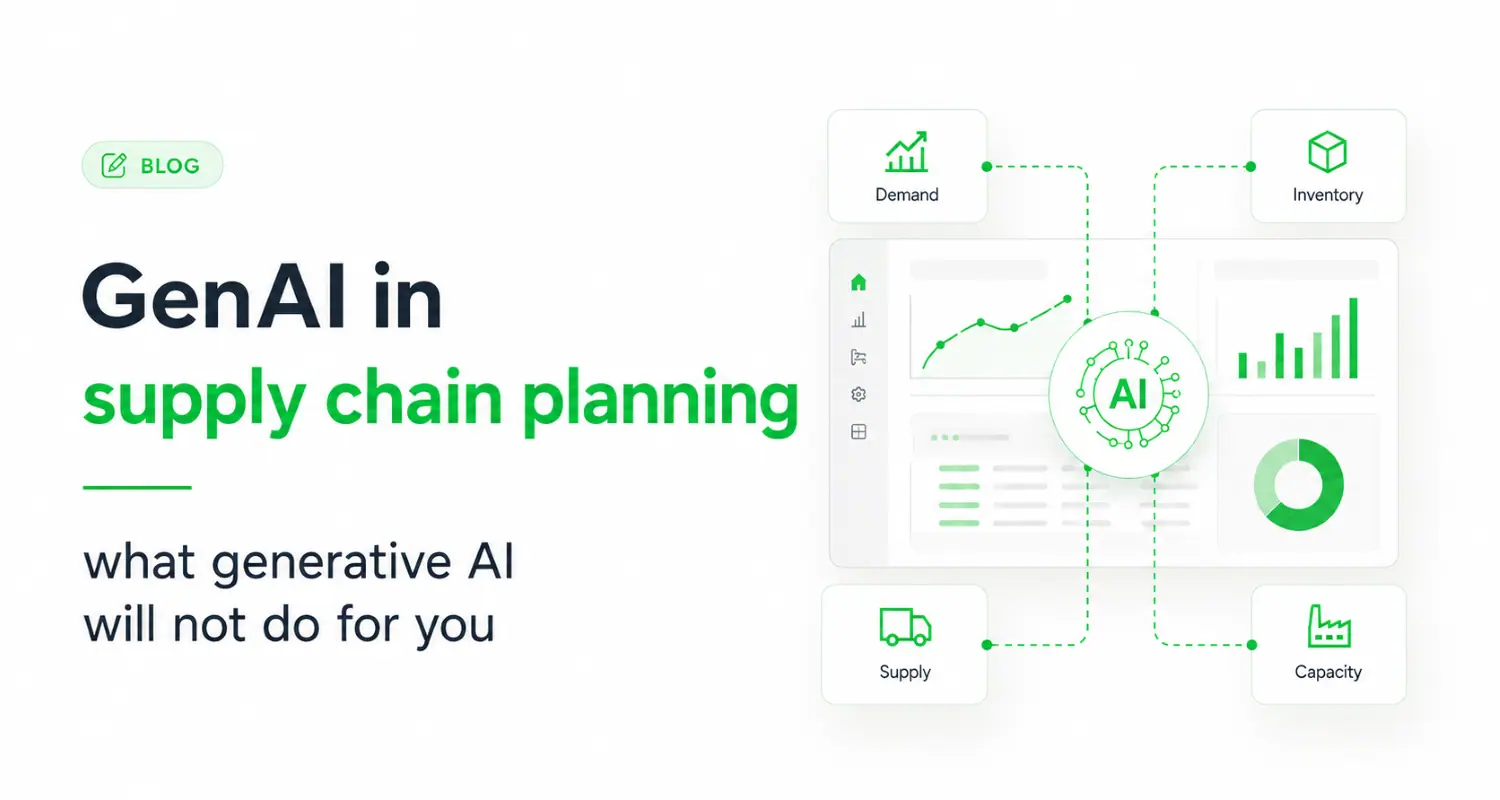
GenAI, or generative AI, is creating high expectations in supply chain. It promises to accelerate analysis, simplify access to data and help teams make better decisions.
But in supply chain planning, generative AI does not replace the fundamentals. It can help explain a situation, summarize exceptions or analyze scenarios. However, it will not fix poor data, broken processes or a fragile planning model on its own.
GenAI is an accelerator. Not a magic solution.
GenAI will not fix your data
The first limitation of generative AI in supply chain is data quality.
If inventory levels are wrong, supplier lead times are outdated, bills of materials are incomplete or planning parameters are poorly maintained, GenAI will not produce reliable recommendations.
It can make an analysis easier to understand, but it cannot automatically turn bad data into good decisions. Before deploying AI in planning, companies need to make sure their core data is reliable enough.
GenAI will not replace a strong planning process
A good planning process is not only about producing a plan. It must align demand, inventory, capacity, supply and business priorities.
GenAI can help prepare an S&OP meeting, summarize alerts or explain gaps. But it does not define decision rules. It does not decide which customer to prioritize, what inventory level to accept or how to balance service, cost and capacity.
In supply chain, technology supports decision-making. It does not replace governance.
GenAI will not make excess inventory disappear
Generative AI can identify excess inventory and help understand its causes. But it will not move excess stock out of the warehouse by itself.
Excess inventory often comes from deeper issues: over-optimistic forecasts, large batch sizes, poor replenishment parameters, limited visibility on real demand or commercial decisions disconnected from operational constraints.
GenAI can highlight the problem. But only concrete actions on processes, parameters and flow management can solve it.
GenAI will not decide priorities for you
In supply chain, not everything can be optimized at the same time. Reducing inventory, improving service levels, controlling costs and maximizing capacity can sometimes be conflicting objectives.
GenAI can compare scenarios and explain the possible consequences of a decision. But it does not carry the responsibility for the trade-off.
Prioritizing an order, expediting supply or delaying production remains a business decision. AI can support teams, but it does not replace their judgment.
What GenAI can really bring to supply chain planning
GenAI can create real value when used in the right place.
It can help planners analyze faster, understand the root cause of an exception, summarize alerts or query data in natural language. It can also improve collaboration between supply chain, purchasing, production, finance and sales teams.
Its role is to increase the analytical power of teams, not to replace the planning model.
The real challenge: connecting AI, planning and flow-based execution
In a volatile supply chain, a good plan is not always enough. Companies also need to react quickly, prioritize the right actions and manage flows based on real demand.
This is exactly the approach supported by b2wise. The goal is not only to add AI to planning, but to help companies build a more robust, visual and action-oriented planning model.
GenAI can help teams understand better. But supply chain performance also depends on data quality, clear processes and the ability to execute the right decisions at the right time.
Conclusion
GenAI in supply chain planning can accelerate analysis, improve collaboration and make decisions easier to understand. But it will not fix data, processes, inventory or priorities on its own.
Generative AI is a powerful lever, provided it is integrated into a solid planning model.
To create value, companies must first strengthen their fundamentals: reliable data, clear processes, decision governance and flow-based execution connected to real demand.

.webp)