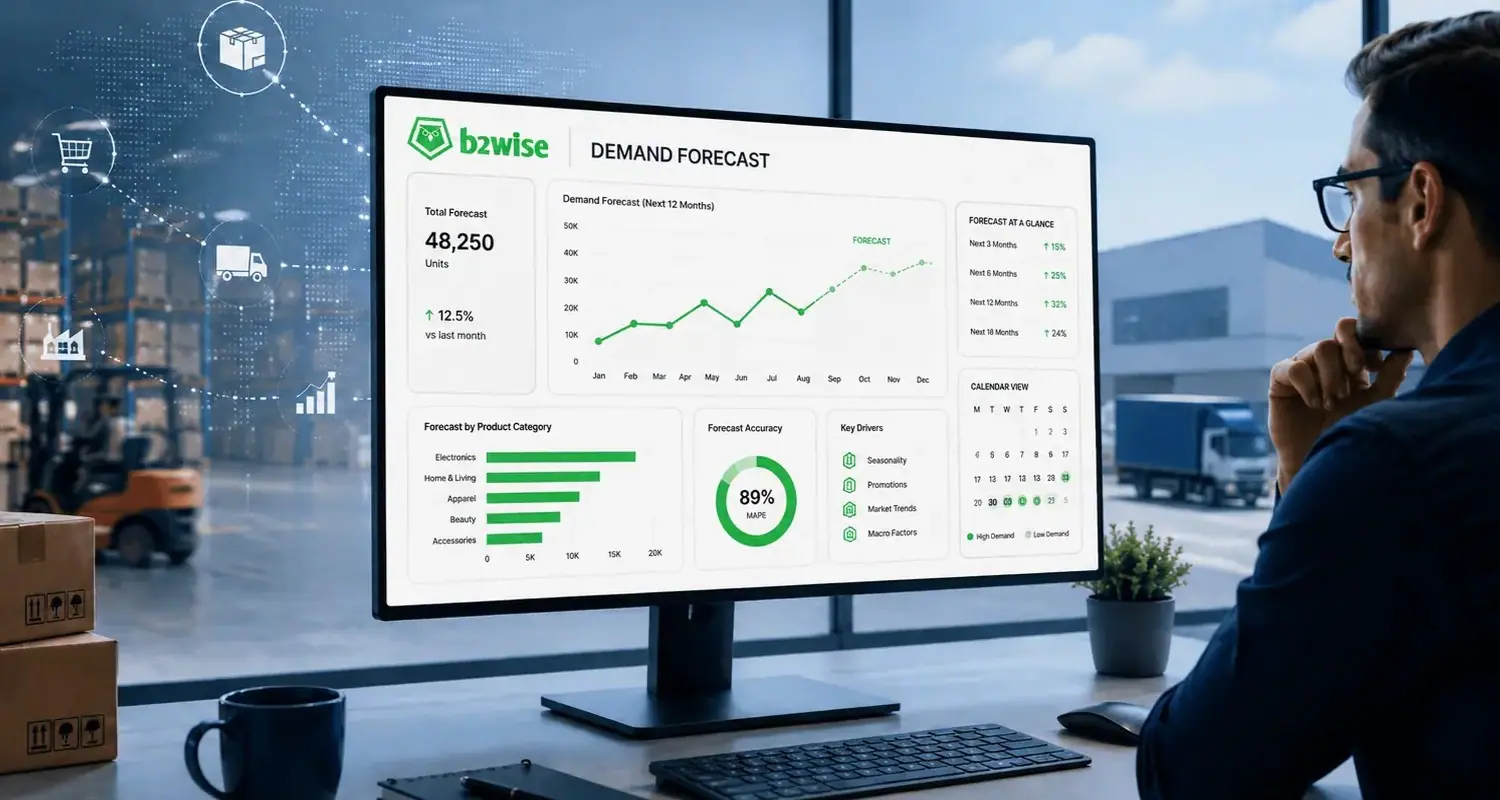
Demand forecasting is one of the most important processes in supply chain planning. It helps companies estimate future customer demand so they can make better decisions about inventory, production, purchasing, capacity and service levels.
But demand forecasting is not about predicting the future perfectly.
No forecast will ever be 100% accurate. Markets change, customers behave differently, promotions shift demand, suppliers are late and unexpected events can disrupt even the best plan.
The real goal of demand forecasting is to create a reliable, stable and actionable view of future demand. A good forecast helps teams make better decisions, align around the same assumptions and respond faster when reality changes.
What is demand forecasting?
Demand forecasting is the process of estimating future customer demand for a product, product family, market, channel or business unit.
It uses historical sales data, customer orders, market trends, seasonality, promotions and statistical models to anticipate what customers are likely to buy in the future.
In supply chain planning, demand forecasting helps answer important questions: how much demand should we expect, which products are likely to grow or decline, how much inventory is needed, where capacity may be constrained and how teams should prepare for future demand.
A demand forecast is not just a number. It is a planning input that influences purchasing, production planning, inventory levels, replenishment, S&OP, financial planning and customer service.
That is why demand forecasting should not be treated as a purely statistical exercise. It is a business process that connects data, people and decisions.
Why is demand forecasting important?
Demand forecasting is important because it helps companies prepare before demand actually happens.
Without a reliable forecast, teams often react too late. They may buy too much of the wrong product, not enough of the right product, overload production capacity or miss customer demand.
Poor forecasting can create stockouts, excess inventory, urgent orders, unstable production plans, higher logistics costs and lower service levels.
A better forecast helps companies make decisions earlier and with more confidence. Supply chain teams can plan replenishment and inventory. Production teams can anticipate capacity needs. Finance teams can estimate revenue and cash flow. Sales teams can align commercial actions with supply constraints.
When demand forecasting is done well, it becomes a common language between departments. It helps the organization move from reactive firefighting to proactive planning.
Demand forecasting vs demand planning
Demand forecasting and demand planning are closely related, but they are not the same thing.
Demand forecasting estimates future demand. Demand planning uses that forecast to build an actionable plan.
A simple way to understand the difference is this:
Demand forecasting creates the demand signal. Demand planning turns that signal into a plan.
For example, a statistical model may generate a forecast for a product family. The demand planning process will then review that forecast, add market knowledge, consider promotions, challenge assumptions and align the final plan with sales, supply chain and finance.
This distinction matters because companies often focus too much on the mathematical forecast and not enough on the process around it.
A forecast may be statistically strong, but if it is not trusted, reviewed and connected to decisions, it will not improve supply chain performance.
Main demand forecasting methods
There is no single best demand forecasting method. The right approach depends on the product, the market, the planning horizon and the quality of the available data.
Some companies use simple methods such as moving averages to smooth historical demand. Others use exponential smoothing to give more weight to recent data. Seasonal forecasting is useful when demand follows recurring patterns, such as holidays, weather effects or annual cycles.
Causal forecasting goes further by looking at the factors that influence demand, such as price, promotions, marketing campaigns, economic indicators or customer behavior.
More advanced companies may also use machine learning to detect complex patterns across large volumes of data. This can be useful, but it is not a magic solution. Even advanced models need clean data, clear business rules and human validation.
In practice, most companies need a combination of statistical forecasting and business input. Historical data can show patterns, but sales, marketing and supply chain teams often have context that the data alone cannot explain.
Common demand forecasting challenges
Demand forecasting is difficult because demand is influenced by many variables.
The first challenge is forecast accuracy. If the forecast is too high, the company may create excess inventory. If the forecast is too low, it may miss sales and disappoint customers.
The second challenge is forecast stability. A forecast that changes too much from one cycle to another can create nervousness in the supply chain. Even if the forecast looks accurate on paper, it may be difficult to execute if it keeps moving.
The third challenge is data quality. Missing sales history, unrecorded lost sales, stockouts, poor promotional data or outdated master data can all reduce forecast reliability.
The fourth challenge is collaboration. Sales, finance, supply chain and operations may each have a different view of demand. Without a clear process to align these views, the forecast can become a source of conflict instead of a shared planning input.
This is why improving demand forecasting is not only about choosing a better algorithm. It is about creating a better planning process.
How to improve demand forecasting
Improving demand forecasting starts with clarity. Companies need to define what the forecast is used for. A forecast used for financial planning does not need the same level of detail as a forecast used for daily replenishment.
The next step is to segment demand. Stable products, seasonal products, slow movers, new products and intermittent demand items should not always be forecasted in the same way.
Data quality is also critical. Historical sales, promotions, stockouts, substitutions and lost sales should be reviewed carefully because they can distort the forecast.
A strong forecasting process also combines statistical models with business knowledge. Sales and marketing teams may know about upcoming promotions, customer changes or market shifts that are not visible in historical data.
Finally, companies should measure forecast performance. Accuracy matters, but it is not enough. A good forecast should also be stable, explainable and actionable.
The best forecasts are not only mathematically correct. They help people make better decisions.
Demand forecasting in a demand-driven supply chain
Demand forecasting plays an important role in supply chain planning, but it should not be the only signal used to make decisions.
In a demand-driven supply chain, forecasts help companies look ahead, while actual demand signals help guide execution.
This matters because forecasts are always uncertain. If a supply chain depends only on forecasts, it can become unstable when reality changes.
A demand-driven approach uses the forecast where it adds value, but also relies on actual demand, buffers, priorities and flow signals to guide daily decisions.
Forecasting helps companies prepare. Demand-driven planning helps companies respond.
Together, they create a supply chain that is more prepared, more responsive and more resilient.
Conclusion
Demand forecasting is the process of estimating future customer demand to support better business and supply chain decisions.
It helps companies plan inventory, production, purchasing, capacity, finance and service levels.
But demand forecasting should not be seen as an attempt to predict the future perfectly. The future will always contain uncertainty.
The real objective is to build forecasts that are reliable, stable and actionable.
A good demand forecasting process combines data, statistical models, market knowledge, collaboration and continuous improvement. It helps teams make better decisions and prepares the supply chain to respond when demand changes.
For companies that want to improve supply chain performance, demand forecasting is a critical starting point. But the best results come when forecasting is connected to demand planning, execution and a broader demand-driven approach.
Want to build more stable and actionable forecasts for your supply chain? Request a demo with b2wise.


.webp)