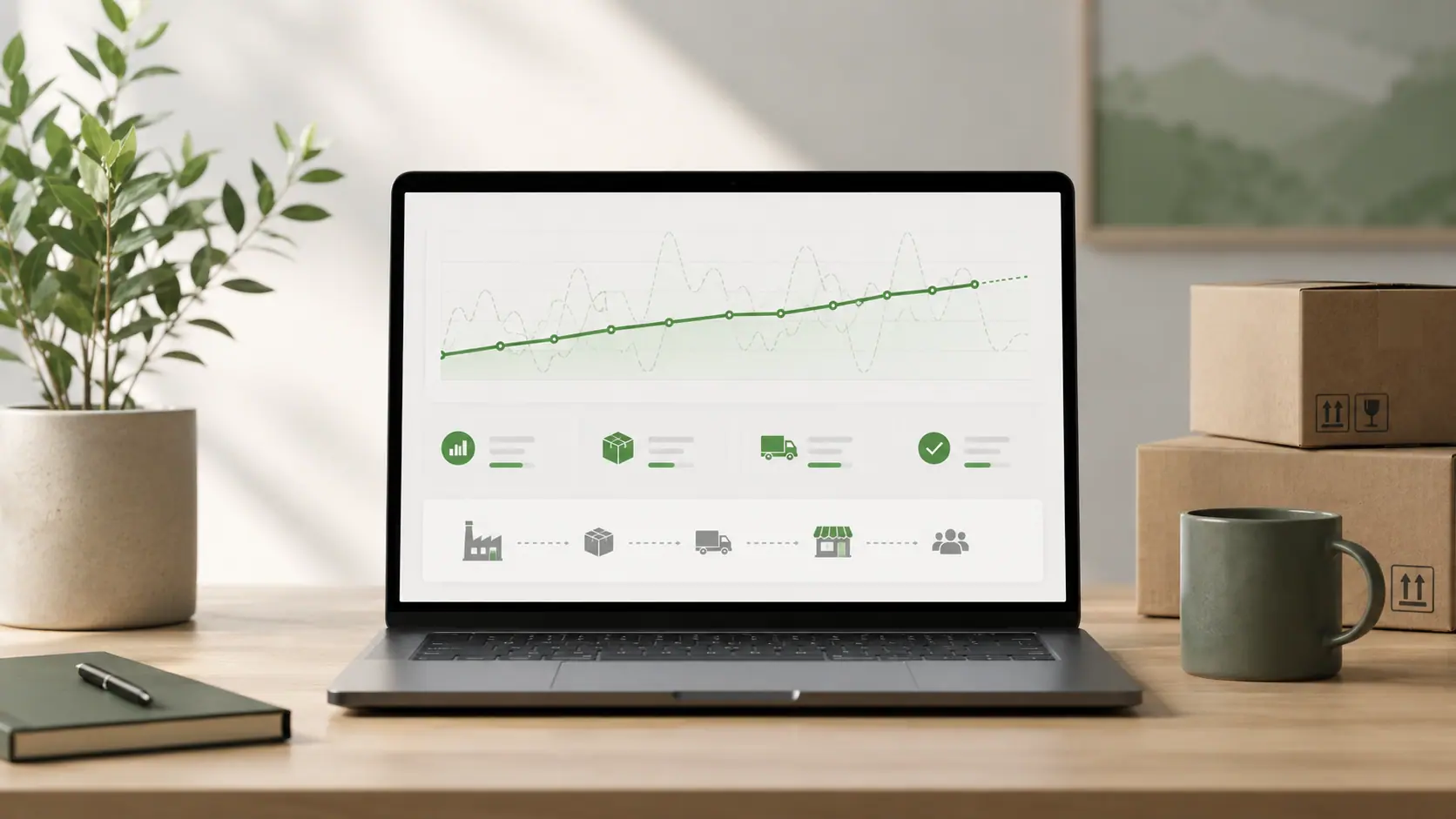
In demand planning, many companies focus heavily on forecast accuracy. They want the forecast to be as close as possible to actual demand. This makes sense: better forecasts can support better decisions around inventory, production, purchasing, capacity and service levels.
But accuracy is not the only thing that matters.
A forecast can be accurate on paper and still create problems in execution. If it changes too often, if every small variation triggers a new decision, or if teams keep reacting to short-term noise, the supply chain can become unstable.
That is why forecast stability is so important.
A stable forecast does not mean a forecast that never changes. It means a forecast that changes for the right reasons, at the right level and at the right time. In demand planning, stability helps teams avoid unnecessary adjustments, protect operational execution and make better decisions across the supply chain.
The goal is not to choose between accuracy and stability. The goal is to balance both.
Forecast accuracy is important, but not enough
Forecast accuracy measures how close a forecast is to actual demand. It is an important metric because it helps companies understand whether their demand signal is reliable.
However, focusing only on accuracy can create a dangerous behavior: constant short-term adjustment.
When teams try to make every forecast update perfectly precise, they may react to every small movement in demand. A minor change in sales history, a short-term customer order variation or a small promotional effect can trigger a new forecast update.
At first, this may look like a more responsive process. In reality, it can create instability.
Production schedules may change too frequently. Procurement orders may be adjusted again and again. Inventory targets may move in different directions. Suppliers may receive mixed signals. Planners may spend more time managing changes than making decisions.
This is especially risky inside the operational horizon, where the business needs stability to execute.
A forecast that is constantly changing can create more noise than value.
What is forecast stability?
Forecast stability is the ability of a forecast to remain consistent enough to support planning and execution.
A stable forecast can still evolve. It should change when the business context changes. It should reflect meaningful shifts in demand, market conditions, promotions, customer behavior or product lifecycle.
But it should not move constantly without a clear reason.
In demand planning, a stable forecast helps teams answer practical questions:
Is this change important enough to act on?
Will this variation affect inventory, capacity or service levels?
Should we update the plan, or can the system absorb the change?
Are we reacting to real demand or just short-term noise?
This distinction is critical.
Not every forecast change should trigger an operational response. Some variations are normal. Some are covered by buffers. Some have no real impact on supply plans.
A stable forecast helps teams focus on the changes that matter.
Why unstable forecasts hurt supply chain execution
An unstable forecast creates nervousness in the supply chain.
When the forecast moves too much from one cycle to another, the entire planning system becomes more reactive. A small change in demand can create a large change in orders, inventory or production plans.
This can lead to frequent production schedule changes, unnecessary procurement adjustments, higher inventory in the wrong places, shortages on critical items, urgent orders and lower trust between planning, sales and operations.
The issue is not only the forecast itself. The issue is the way the organization reacts to it.
If every small forecast variation becomes an action, teams lose focus. They start treating noise as if it were a real signal.
This is why stable forecasting is not only a statistical topic. It is an operational discipline.
Stable forecast in demand planning: finding the right balance
A stable forecast supports better demand planning because it creates a more reliable foundation for decision-making.
Demand planning is not only about generating a forecast. It is about using that forecast to build an actionable plan. That plan must connect sales, supply chain, finance, operations and procurement around a shared view of future demand.
If the forecast is unstable, that shared view becomes difficult to maintain.
Sales may challenge the numbers. Supply chain may lose trust in the demand signal. Operations may struggle to plan capacity. Finance may question revenue assumptions. Planners may start using spreadsheets to create their own version of the truth.
A stable forecast helps avoid this.
It gives teams enough consistency to plan, while still allowing the business to respond when real demand changes.
In other words, the forecast should be stable enough to execute, but flexible enough to adapt.
That balance is where demand planning becomes powerful.
Forecast stability in a demand-driven environment
In a demand-driven environment, forecast stability plays a specific role.
Demand-driven planning is designed to protect flow by using buffers, decoupling points and demand-driven replenishment. Instead of making every operational decision directly dependent on the latest forecast, buffers help absorb normal variability.
This changes how the forecast is used.
The forecast remains important, but it is no longer the only source of truth. It supports planning, while actual demand, buffer status and flow signals help guide execution.
This means the supply chain does not need to react to every small forecast movement.
If demand stays within a normal range, the system can avoid unnecessary replanning. If demand moves outside that range, the buffer status helps planners see where action is needed.
This creates a more stable and responsive planning process.
The forecast helps teams prepare. Buffers help teams absorb variability. Demand-driven execution helps teams respond when action is truly needed.
Operational forecasting vs strategic forecasting
Forecast stability does not mean using the same forecast in the same way everywhere.
In the operational horizon, stability is critical. Teams need a plan that can be executed. Constant changes can create disruption, extra costs and lower service performance. In this context, the forecast should support flow and avoid unnecessary nervousness.
In strategic planning, the role of the forecast is different. The business needs to evaluate future risks, demand shifts, capacity needs, revenue opportunities and potential constraints.
Strategic forecasting may require scenarios. For example, what happens if demand grows faster than expected? Do we need more capacity? What is the revenue impact if we cannot supply the forecasted demand? Should we adjust inventory strategy?
At this level, forecast changes can be useful because they help the business prepare for bigger decisions.
The key is to avoid confusing strategic flexibility with operational instability.
A forecast can be flexible at strategic level and stable at operational level.
How to build a more stable forecast
Building a more stable forecast requires both process and discipline.
First, companies need to define when a forecast change is meaningful. Not every variation should trigger a planning reaction. Teams should agree on thresholds that separate normal variability from real demand change.
Second, demand planning should happen at the right level of aggregation. Some adjustments are more useful at product family, customer group or market level than at item level. Working at the right level can reduce noise and speed up decisions.
Third, forecast changes should be connected to business context. Promotions, customer changes, market trends and product lifecycle events can justify forecast adjustments. Random short-term variation should be treated more carefully.
Finally, companies should measure forecast accuracy, bias and stability together. Accuracy shows how close the forecast is to reality. Bias shows whether it is consistently too high or too low. Stability shows whether the forecast changes too much between planning cycles.
Together, these indicators provide a more complete view of forecast quality.
The best forecast is not always the one that changes most often. It is the one that helps the business make better decisions.
Conclusion
A stable forecast is essential in demand planning because it helps companies balance accuracy with execution.
Forecast accuracy remains important. But if the forecast changes too often, it can create instability across production, procurement, inventory and supply planning.
Forecast stability helps reduce noise. It helps planners focus on meaningful demand changes. It supports better collaboration between sales, operations, finance and supply chain. It also helps the business protect service levels while avoiding unnecessary inventory and operational disruption.
The most effective demand planning processes do not chase the perfect number. They build forecasts that are accurate enough, stable enough and useful enough to support better decisions.
That is what creates a more resilient, efficient and profitable supply chain.
Want to build more stable forecasts and improve your demand planning process? Request a demo with b2wise.

.webp)