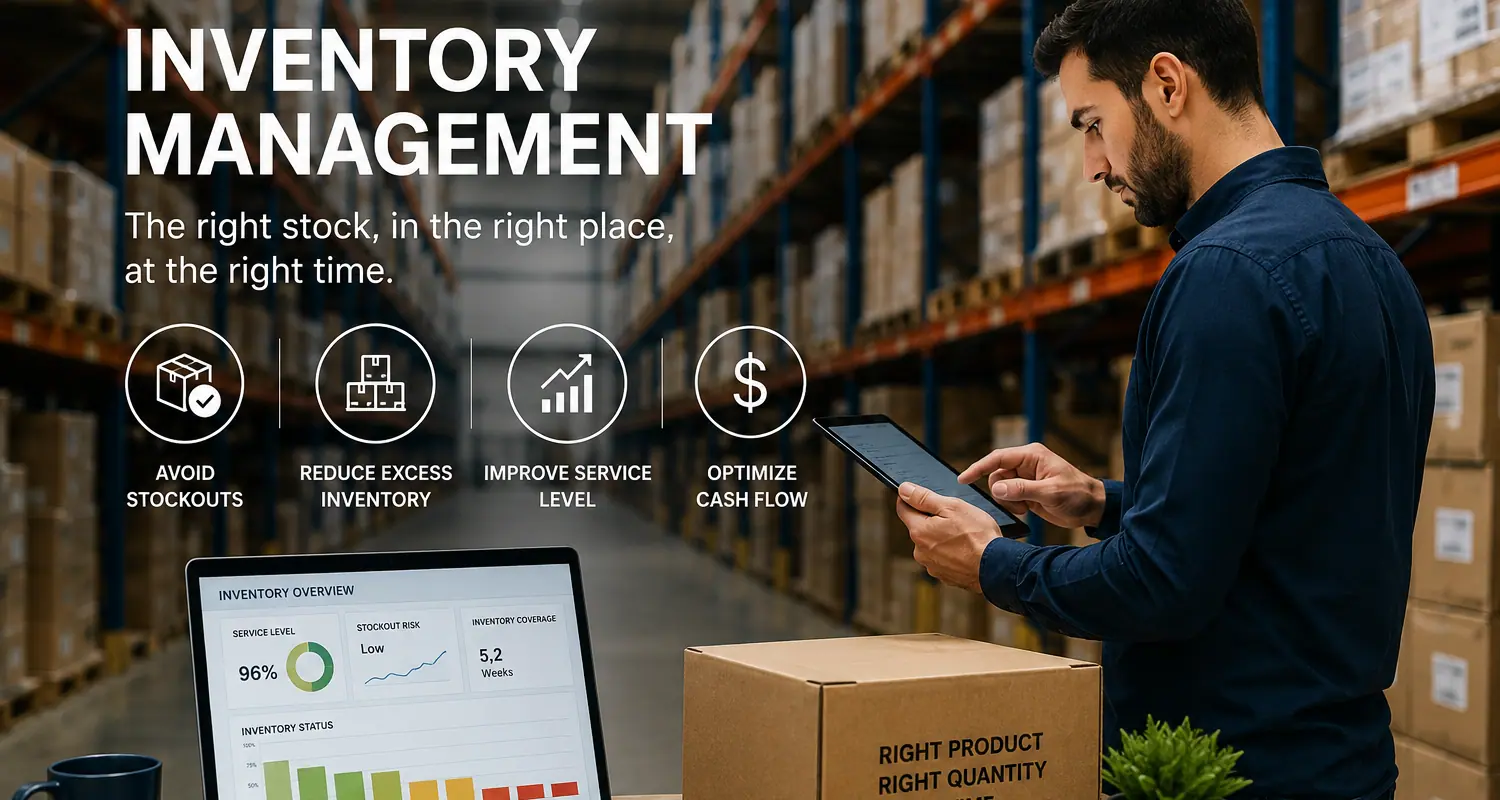
Inventory management is one of the key balancing acts in supply chain. Too little inventory, and the company faces stockouts, delivery delays and lost revenue. Too much inventory, and it ties up cash, increases logistics costs and sometimes hides deeper planning issues.
That is what makes the topic so difficult. Good inventory management is not simply about “reducing stock”. It is about maintaining the right level of inventory, in the right place, at the right time.
In a stable environment, traditional replenishment rules may be enough. But as soon as demand becomes more variable, supplier lead times increase or customer priorities shift, these rules quickly reach their limits. Companies then face a familiar paradox: stockouts on some items and excess inventory on others.
What is inventory management?
Inventory management refers to the methods and tools used to control the quantities available across the company: raw materials, components, finished goods, spare parts or stock in transit.
Its objective is easy to state, but harder to achieve: ensure the availability of the items needed while avoiding excessive capital tied up in inventory.
To do this, companies need to answer very practical questions. Which items are truly critical? Which products have stable or unpredictable demand? Which inventories protect customer service? Which stocks are costly without adding real value? And most importantly: when should the company replenish, and in what quantity?
Inventory management is therefore an operational, financial and strategic topic.
Why is inventory management so strategic?
Inventory is often seen as a cost. That is true, but it is only part of the story. Inventory also plays a protective role. It helps absorb demand variation, supplier delays, production constraints and operational disruptions.
The problem appears when this protection is poorly positioned.
A company can have a high overall inventory level and still suffer from stockouts. Conversely, it can drastically reduce inventory and damage its service level. Good inventory management therefore does not depend only on the total volume of stock, but on its location, its composition and its ability to protect the right items.
That is why a one-size-fits-all approach rarely works. Not all items deserve the same level of protection. A critical component with a long supplier lead time should not be managed in the same way as a stable, low-cost product that is easy to replenish.
The real problem: stockouts and excess inventory at the same time
Many companies experience the same situation: too much inventory, but not enough availability.
This paradox often comes from a lack of segmentation, outdated planning parameters or overly rigid replenishment rules. Inventory builds up on items with low demand, while critical items regularly come under pressure.
Stockouts create emergencies, express shipments, planning changes and loss of customer confidence. Excess inventory ties up cash, clutters warehouses and increases the risk of obsolescence.
So the right question is not: “How can we reduce inventory?”
The real question is: “How can we reduce bad inventory while protecting the right stock?”
How to improve replenishment
Good replenishment does not rely only on a forecast. Forecasting is useful, but it remains uncertain. It must be complemented by real demand, consumption, lead times, customer priorities and current inventory status.
The first lever is to segment items. Some items need to be protected because they are critical for customer service or production. Others can be managed with lower levels because they are less sensitive or easier to replenish.
The second lever is to regularly review planning parameters. Inventory levels, lead times, lot sizes and safety stocks should not remain frozen for years. Demand changes, suppliers evolve, markets become tighter and rules need to follow.
The third lever is prioritization. Not all alerts have the same importance. Planners need to know which items truly threaten the service level and which orders should be handled first.
This is where a modern planning system brings value: it does not simply display stock levels. It helps teams make better decisions.
The role of buffers in more dynamic inventory management
In a Demand Driven approach, buffers play a central role. They help protect important items against variability without adding inventory everywhere.
A buffer is not just a safety stock. It is a control mechanism. It helps visualize which items are under pressure, which are properly protected and which are overstocked.
This logic allows companies to move from static inventory management to a more dynamic approach. Instead of triggering replenishment only through fixed rules, the company can rely on the real status of buffers and actual consumption.
DDMRP follows this logic. It positions buffers at strategic points in the supply chain to protect flow, absorb variability and prioritize replenishment.
The objective is not to predict the future perfectly. The objective is to create a system that can respond properly when reality deviates from the plan.
Which indicators should you track?
To manage inventory effectively, looking only at the total value tied up in stock is not enough. Inventory must be connected to operational performance.
Service level remains a key indicator because it measures the ability to meet demand. The stockout rate helps identify items or product families that create recurring issues. Inventory turnover gives an indication of how quickly stock is consumed. Stock coverage helps understand how long the company can operate with the inventory available.
But no indicator should be interpreted in isolation. High coverage may be justified for a critical item with a long replenishment lead time. Low coverage may be acceptable for a stable item that is easy to reorder.
The quality of inventory management comes from reading these indicators together, not from applying one rule to every item.
How to avoid stockouts without increasing excess inventory
This is the heart of the challenge.
Adding inventory everywhere can reduce some stockouts in the short term, but this approach often becomes expensive. Reducing inventory everywhere can temporarily improve cash, but it weakens customer service. In both cases, the company treats the symptom rather than the root cause.
To avoid stockouts without creating excess inventory, decisions must be differentiated. Critical items need to be protected. Less sensitive items need to be managed more precisely. Parameters must be adjusted regularly. And replenishments must be prioritized according to real risk.
Performance therefore comes less from an “ideal” inventory level than from a system capable of continuously adjusting decisions.
How b2wise helps optimize inventory management
b2wise helps companies move from static inventory management to more dynamic, connected and demand-driven planning.
The solution makes it easier to visualize priorities, monitor buffers, identify stockout risks and limit excess inventory. Teams no longer manage only quantities. They manage signals, priorities and risk zones.
With a Demand Driven approach, planners can focus on what truly threatens flow. They gain visibility, reduce firefighting and make better replenishment decisions.
The objective is not simply to hold less inventory. The objective is to have the right inventory, in the right place, at the right time.
Conclusion
Inventory management is a major driver of supply chain performance. It directly affects service level, cash, operational stability and customer satisfaction.
But in a volatile environment, overly static approaches are no longer enough. Companies need to better segment their items, connect forecasts with real demand, adjust parameters and prioritize replenishment based on risk.
The best supply chains are not the ones with the lowest inventory. They are the ones that know exactly which stocks to protect, where to position them and when to replenish them.


.webp)